Mode
0–7 · 8 Engines
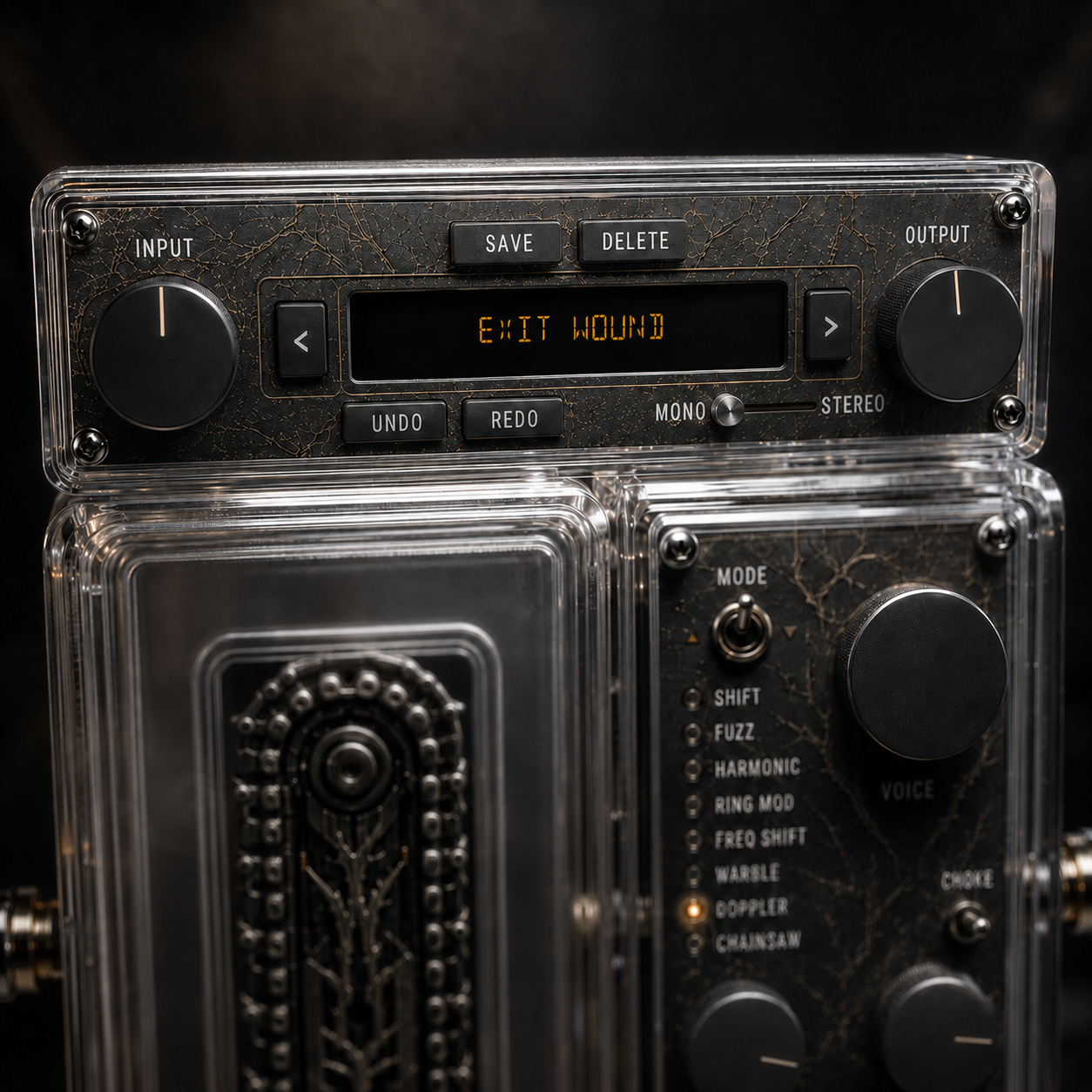
Selects the active DSP architecture. Each position is a different engine with its own physics, its own character, and its own state memory. Switch to a mode you've never touched and you get curated defaults — every parameter set to a starting point that actually sounds like something. Switch back to a mode you've used before and you get exactly what you left.
Amount
0–100% · Rocker Pedal
Effect intensity, mapped to the physical rocker pedal. What it controls depends on the mode. Voice gain in the pitch engines. Drive intensity with cubic taper in FUZZ. Modulation depth in Ring Mod and Warble. Shift frequency multiplier in Freq Shift. Sweep depth in Doppler. One control, eight different behaviors. The rocker animates across 41 frames to match the position.
Voice
0–100% · Character
The shape of the effect. In SHIFT: seven discrete pitch intervals, snapped to musical positions from -24 to +13 semitones. In FUZZ: tilt EQ from dark to bright, with drive boost above the midpoint. In HARMONIC: five octave snap positions. In Ring Mod: carrier waveform morph — sine through triangle to square. In CHAINSAW: cluster width, 1 to 10 semitones. Every mode maps this knob differently.
Blend
0–100% · Dry / Wet
Universal crossfade between unprocessed signal and mode output. Applied after mode processing, before CHOKE, SAT, and TONE. At zero: pure dry. At one: pure wet. Linear interpolation — no surprises. Identical behavior across all eight modes.
Tone
0–100% · Body Saturator
Parallel band-saturator centered at 320 Hz with IIR bandpass at Q 0.8. At zero: bypassed completely, zero CPU cost. As you open it up: the body region passes through asymmetric tanh saturation, producing even harmonics that add warmth and weight without muddying the top end. Drive scales from 1x to 16x. A soft limiter at the output prevents peaks.
Saturation
0–100% · Piecewise Waveshaper
4x oversampled asymmetric clipping with mid-frequency pre-emphasis at 1.2 kHz. Changes both character and level — deliberately. No makeup gain. The knob turns white below 50%, amber from 50–75%, and red above 75%. Drag resistance increases in the amber zone. Increases again in the red. A one-time warning appears when you first cross 50%. It was put there for a reason.
Frequency
0.1–5000 Hz · Log Sweep
Mode-specific frequency parameter with 0.3 skew. Carrier frequency in Ring Mod. Shift amount in Freq Shift. Rate in Warble. Maximum depth in Doppler. Displayed on the LCD in modes that use it. Inactive — and hidden — in SHIFT, FUZZ, HARMONIC, and CHAINSAW.
Bias
0–100% · DC Offset / Rate
In Ring Mod and Warble: DC offset on the carrier oscillator. Shifts the modulation from pure four-quadrant ring mod toward AM-like behavior, with level normalization to prevent volume jumps. In Doppler: LFO rate via exponential mapping — 0.1 Hz at minimum, 20 Hz at maximum. Inactive in other modes.
Rectify
0–100% · Carrier Shape
Half-wave rectification of the carrier in Ring Mod and Warble. LFO symmetry control in Doppler. Warble halves both Bias and Rectify internally before passing them to the DSP — producing gentler modulation at identical knob positions, distinguishing its character from Ring Mod despite sharing the same engine. Inactive in other modes.
Input Gain
0–100% · Silence to +6 dB
Pre-DSP gain with linear taper. The parameter range is 0.0 to 1.0, scaled by 2x internally — noon is unity, full clockwise is +6 dB. Adjusts signal level before any processing touches it. Push harder into the mode engine for more extreme results, or pull back for cleaner textures.
Output Gain
0–100% · Silence to +6 dB
Post-DSP gain. Same 2x linear scaling. Final volume control after every stage has done its work — after mode processing, after BLEND, after CHOKE, after SAT, after TONE. Independent of everything that came before it. This is your master volume.
Mono / Stereo
Toggle · Channel Routing
Stereo processes left and right independently through separate filter instances across every stage. Mono copies channel zero to channel one at the very end of the chain — after all processing, after SAT, after TONE, after output gain. The copy happens last. Everything before it runs in stereo regardless.
Engaged
Toggle · Bypass Footswitch
Hard bypass. When disengaged, processBlock returns the buffer untouched — no processing, no CPU. A semi-transparent overlay covers the entire interface with a radial cutout around the footswitch so you can see it and click it to re-engage. Displays "BYPASSED" across the pedal.
Choke
Toggle · Peak Normalization
Per-block peak measurement with perceptual correction. Available for Ring Mod, Freq Shift, Warble, Doppler, and Chainsaw — the five modes whose output amplitude is unpredictable. Disabled for SHIFT, FUZZ, and HARMONIC. When active: a smoothed gain correction prevents output from exceeding input, and a -2.5 dB shelf at 3 kHz adjusts for perceived loudness.
Shift
Granular pitch shifter with seven discrete intervals. Two octaves down. An octave and a semitone down. One octave down. One semitone down. One semitone up. One octave up. An octave and a semitone up. 15-millisecond grains, 4x overlap, Catmull-Rom interpolation. Positions below -12 semitones receive 2.5x gain compensation — the engine corrects for the natural quietness of sub-octave signals. VOICE snaps to the nearest position. AMOUNT controls voice gain with a 5% floor to prevent dead silence at full wet.
Fuzz
Four cascaded asymmetric soft-clipping stages. Each stage applies hyperbolic tangent compression with different positive and negative thresholds. Drive uses cubic taper for a musical rocker feel — controlled breakup through the first half of the range, calculated destruction through the second. VOICE sweeps a tilt EQ and adds up to 2x drive boost above the midpoint. Output compensation of 0.032x keeps it within 3 dB of the other modes. No subtlety. Pure physics.
Harmonic
Detuned pitch clusters at five discrete octave positions. Two octaves down, one octave down, center bypass, one octave up, two octaves up. Each active position runs four voices — two primary at ±1 semitone from the target octave, two cluster voices at ±1 semitone from unity that fade in as AMOUNT passes 50%. The result: thick, harmonically-rich layers stacked on top of the original signal.
Ring Mod
Amplitude modulation with a configurable carrier oscillator. VOICE morphs the waveform continuously from sine through triangle to square. FREQ sets the carrier from 0.1 Hz to 5 kHz. BIAS adds DC offset for AM-like behavior with level normalization. RECTIFY introduces half-wave rectification. Three LCD columns: FREQ, BIAS, RECT. Metallic, bell-like timbres. Sum and difference frequencies. The sound of two signals being multiplied together.
Freq Shift
Hilbert-transform single-sideband modulation. Every frequency in the signal is shifted by a fixed Hz amount — not a ratio. A 440 Hz fundamental shifted up by 100 Hz becomes 540 Hz. Its second harmonic at 880 Hz becomes 980 Hz. The relationship between them is destroyed. Overtones that were integer multiples become non-integer. The result is inharmonic, dissonant, and alien. VOICE controls direction. FREQ controls shift amount. One LCD column.
Warble
Sub-audio to audio-rate amplitude modulation. Shares the Ring Mod DSP engine, but halves Bias and Rectify internally for gentler character. At low rates: tremolo. At medium rates: flutter. At high rates: the signal stops behaving like audio and starts behaving like a problem. LCD columns relabeled: RATE, BIAS, RECT.
Doppler
LFO-modulated frequency shifting that simulates the Doppler effect. The pitch sweeps up and down cyclically as if the sound source is orbiting the listener. VOICE selects the LFO waveform: sine, triangle, sawtooth, square. FREQ sets maximum shift depth. BIAS controls LFO rate from 0.1 Hz to 20 Hz via exponential mapping. RECTIFY adjusts LFO symmetry. Phase resets on DAW transport start for deterministic behavior across play/stop cycles. LCD columns: DEPTH, RATE, SYMM.
Chainsaw
The namesake. Two detuned pitch voices, symmetrically offset from unity. VOICE controls the spread: 1 to 10 semitones via a two-segment mapping curve. One voice goes down, one goes up, and the space between them is where the signal comes apart. Same 15-millisecond granular engine as SHIFT, same Catmull-Rom interpolation. AMOUNT controls both voices' gain directly. At narrow settings: aggressive chorusing. At wide settings: the sound of something being dismantled.
Blend
True crossfade applied identically to all eight modes. The formula is the simplest one in the plugin: dry times one minus blend, plus wet times blend. At zero you hear only what went in. At one you hear only what came out. No additivity, no gain change, no mode-dependent behavior. Applied after mode processing, before CHOKE, SAT, and TONE.
Choke
Per-block peak normalization with perceptual treble compensation. Measures amplitude before and after mode processing. When the output is louder than the input, a smoothed correction factor brings it back in line — 5-millisecond time constant, no clicking, no pumping. A -2.5 dB high-shelf at 3 kHz compensates for Fletcher-Munson equal-loudness sensitivity. Available for Ring Mod, Freq Shift, Warble, Doppler, and Chainsaw.
Saturation
Piecewise asymmetric waveshaper running at 4x the host sample rate. A pre-emphasis EQ at 1.2 kHz pushes the mids 8 dB forward so they hit the clipper first — frequency-dependent harmonic generation, not flat distortion. Positive threshold at 0.5, negative at 0.7. Even harmonics from the asymmetry. Drive from 1x to 64x. No makeup gain — SAT changes level and character together. The SAT knob has three visual states (white, amber, red) and increasing drag resistance as you push it higher.
Tone
Parallel band-saturator. An IIR bandpass at 320 Hz, Q 0.8, isolates the body region. The isolated signal passes through asymmetric tanh saturation — a DC offset trick that clips positive peaks harder than negative, producing warm even-order harmonics. The saturated body is added back to the original at the level you choose. Drive ranges from 1x to 16x. A soft limiter at the output prevents peaks from the addition. At zero, the processor is completely bypassed — no CPU cost.
Mode Memory
8 Independent Parameter Banks
Every mode maintains its own state. Set FUZZ exactly where you want it. Switch to DOPPLER. Adjust the rate. Switch back to FUZZ — your drive setting is exactly where you left it. First visit to any mode loads curated defaults — every parameter tuned to a starting point that demonstrates what the engine can do. Every subsequent visit restores your last configuration. All eight states serialize with your DAW project. All eight persist with your presets. Switch modes mid-session, mid-song, mid-take. Nothing gets lost.
Save unlimited user presets. Full undo support — delete a preset by accident, bring it back instantly. All names display in uppercase. User presets stored locally in %APPDATA% and persist between sessions. Navigation is circular: 16 factory presets, then your own, with an INIT state at the beginning of the cycle.