EARLY ACCESS DOWNLOAD
LICENSE KEY REQUIRED
Private early access release. Activation requires a valid license key.
6
parallel pitch voices
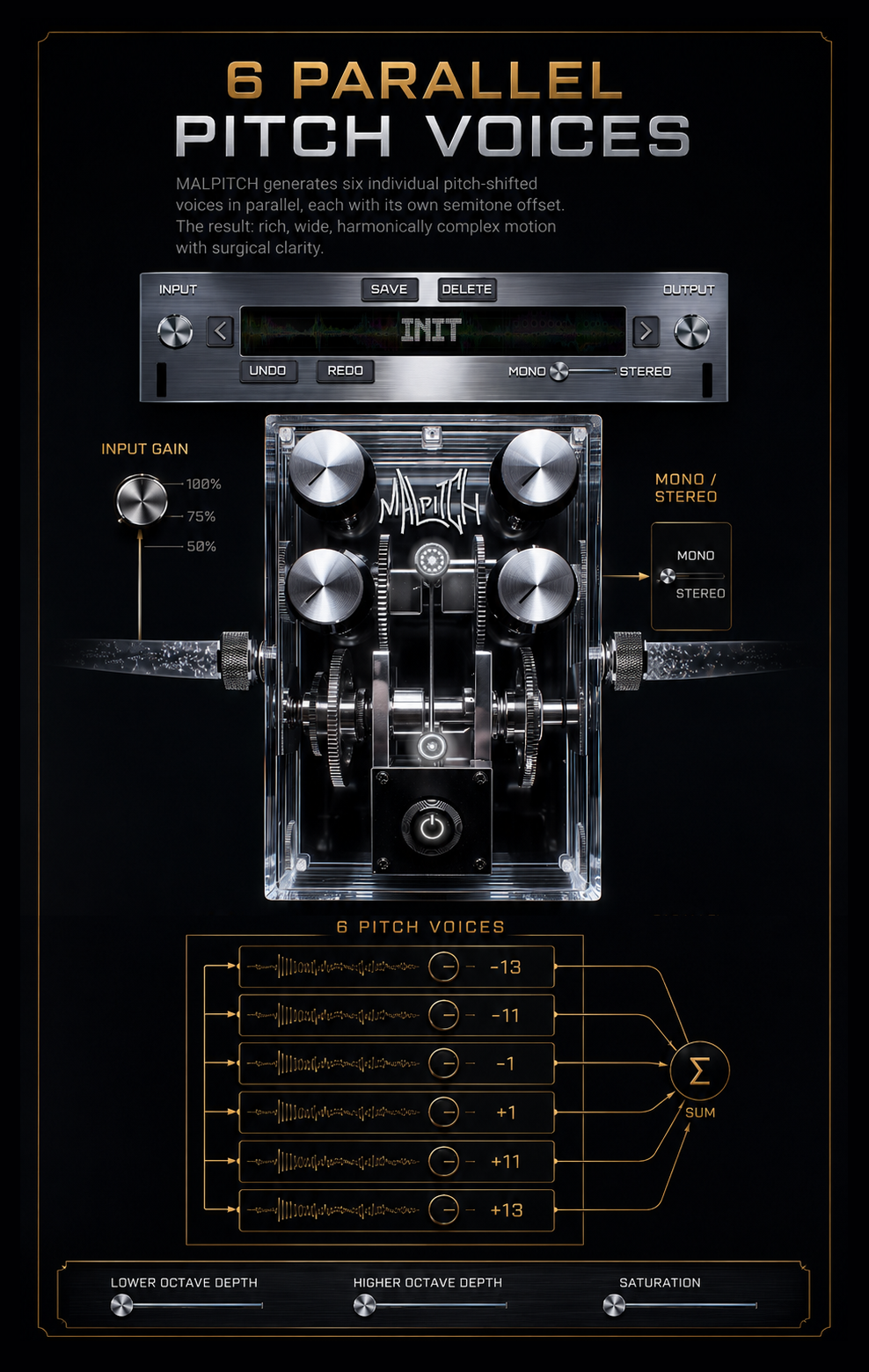
Not six copies of one algorithm. Six independent granular pitch shifters running simultaneously, each reading from its own grain buffer, each shifting to a different interval. The primary voices detune by a single semitone in each direction. The extended voices reach an octave further — but every octave voice is offset by a minor second, so dissonance doesn't resolve as you move through the spectrum. It scales.
MALPITCH GUI full pedal interface
Primary Voices
±1 Semitone
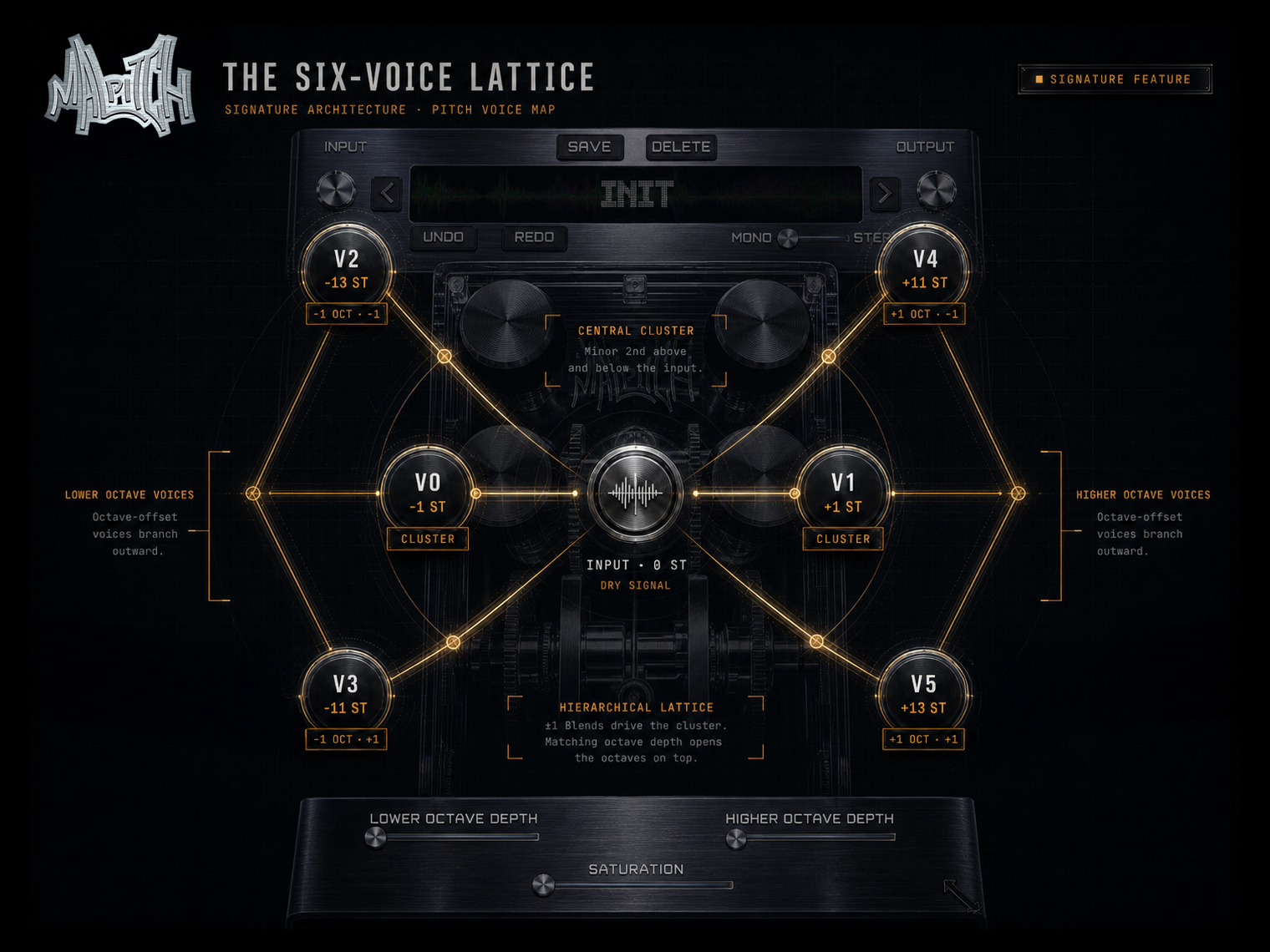
The foundation. Two voices, each shifting the input by a single semitone — one down, one up. A minor second in both directions. At low blend levels they add thickness and width the way a chorus does, but without the modulation. At higher levels the dissonance becomes the point. Two independent blend knobs let you weight the detuning in either direction, or push both sides equally for a symmetric shimmer that sits around your dry signal like a second skin.

The smallest interval carries the most tension.
Extended Voices
Octave Depth
Four more voices live one octave below and above the primaries. Not clean octaves — each one is offset by that same minor second, so the lower voices land at -13 and -11 semitones while the higher voices reach +11 and +13. They only activate when a primary blend is turned up. The octave depth controls scale them against the primary level, so they always stay proportional. Turn everything up and the six voices span nearly three octaves of stacked dissonance.

The spectrum doesn't resolve. It multiplies.
MALPITCH voice interaction visualization
What it carries
Ghost
Ghost
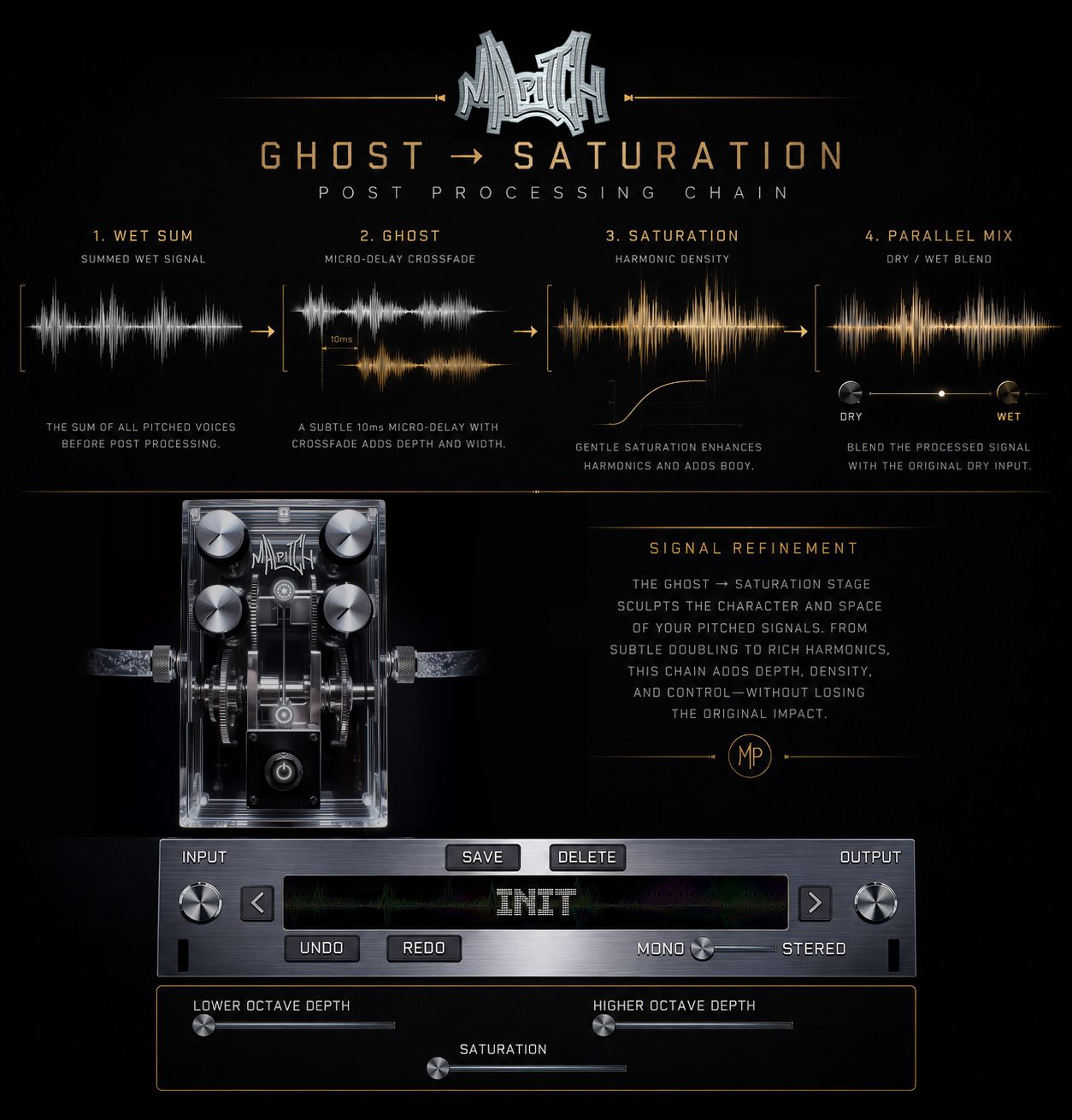
A 10ms micro-delay applied after pitch shifting, before saturation. At low settings it doubles and thickens the shifted signal. Push it further and phase interference takes over — metallic flanging, shimmering artifacts, textures that shouldn't exist.
Saturation
Saturation
Soft-clipping with even harmonic generation. The drive range goes from gentle warmth to full compression, applied to the wet signal only. Your dry signal stays untouched underneath. The saturation stage turns dissonance into something physical.
Parallel Mix
Parallel Mix
Additive blend — not a crossfade. Your dry signal is always present at full level. Turning mix up adds the processed signal on top. At zero, silence. At full, the entire pitch-shifted, ghosted, saturated chain stacks onto your original.
Zero Latency
Zero Latency
The granular engine introduces roughly 30ms of grain latency from the pitch shifting itself, but there's no added buffer delay. Real-time processing. Your DAW compensates automatically, and the signal stays responsive enough to play through live.
True Stereo
True Stereo
Independent left and right processing through separate grain buffers and delay lines. Each channel shifts on its own, creating natural spatial width. Or sum to mono with one toggle — the switch is on the top panel, one click away.
20 Presets
20 Presets
Factory presets from subtle thickening to full spectral obliteration. Every one designed to show a different face of the engine. Save your own with full undo — delete something by accident, bring it back instantly. Everything persists between sessions.
Post-processing chain
GHOST → SATURATE
The order matters. Ghost is applied after pitch shifting and before saturation — a 10ms delayed copy of the wet signal crossfaded with the original, then driven into the soft-clipping stage. Saturating a ghosted signal produces different harmonics than ghosting a saturated signal. The phase interference from Ghost creates comb-filtering artifacts that the saturation stage then compresses and reshapes into new overtones. Neither effect can produce these textures alone. The interaction is the instrument.

At low settings both stages are invisible — gentle thickening, subtle warmth. Push them together and the signal starts folding in on itself, producing dense harmonic content that sits somewhere between distortion and synthesis.
MALPITCH Ghost and Saturation controls
Built for the session
Presets
20 factory presets designed to cover the full range of the engine. Save your own with one click. Full undo — delete a preset by accident, bring it back instantly. Everything uppercase. Everything persistent.
Resize
Three fixed sizes — 50%, 75%, 100%. Click to switch. The interface scales proportionally. Small enough for a crowded plugin chain, large enough to see every detail of the pedal artwork.
Recall
Full state persistence. Every parameter, every GUI preference — saved with your DAW session and restored exactly as you left it. Open the project, pick up where you stopped.
Questions
VST3 in both 32-bit and 64-bit. Compatible with any DAW that supports VST3 on Windows. macOS support is in development — Windows and macOS will be separate releases.
No. Windows and macOS are separate purchases when the macOS version becomes available. Purchasing the Windows version does not guarantee access to the macOS version.
Offline validation — no internet required after purchase. Your license key is bound to your machine on first activation. The honor system allows use on up to 2 machines per purchase. If you change computers, contact support for a key reset.
All digital purchases are final due to the nature of downloadable software. Once delivered, the product cannot be returned. If you have issues with installation or activation, contact support and we'll help.
Six granular pitch voices with 4x grain overlap each is the main cost. Voices only process when their blend is above zero, so a single-voice patch uses a fraction of the full engine. On any modern processor it runs comfortably with headroom to spare. No sample libraries — pure DSP, negligible RAM.
Not currently. The price is $15. We kept it low enough that the barrier to entry is the trial.
Requirements
Format
VST3
Platform
Windows
CPU
x86 / x64
Latency
~30ms
GUI
Resizable