Private early access release. Activation requires a valid license key.
200x
the gain of a conventional overdrive
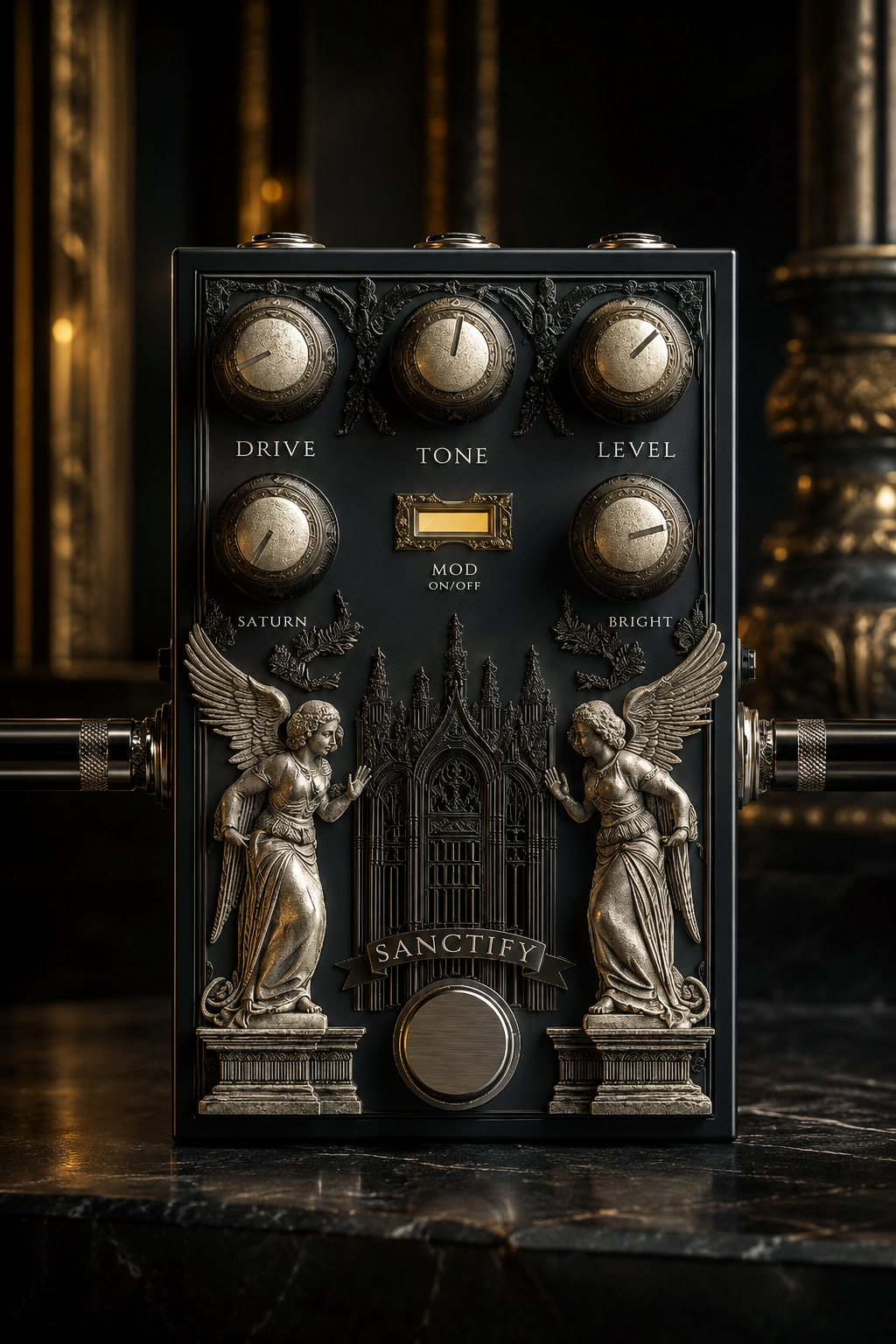
Most overdrives top out around 20x gain. Sanctify's drive stage uses a two-range curve that accelerates past that into territory where the signal stops being amplified and starts being reshaped. The circuit doesn't clip — it transforms.
Mode One
808
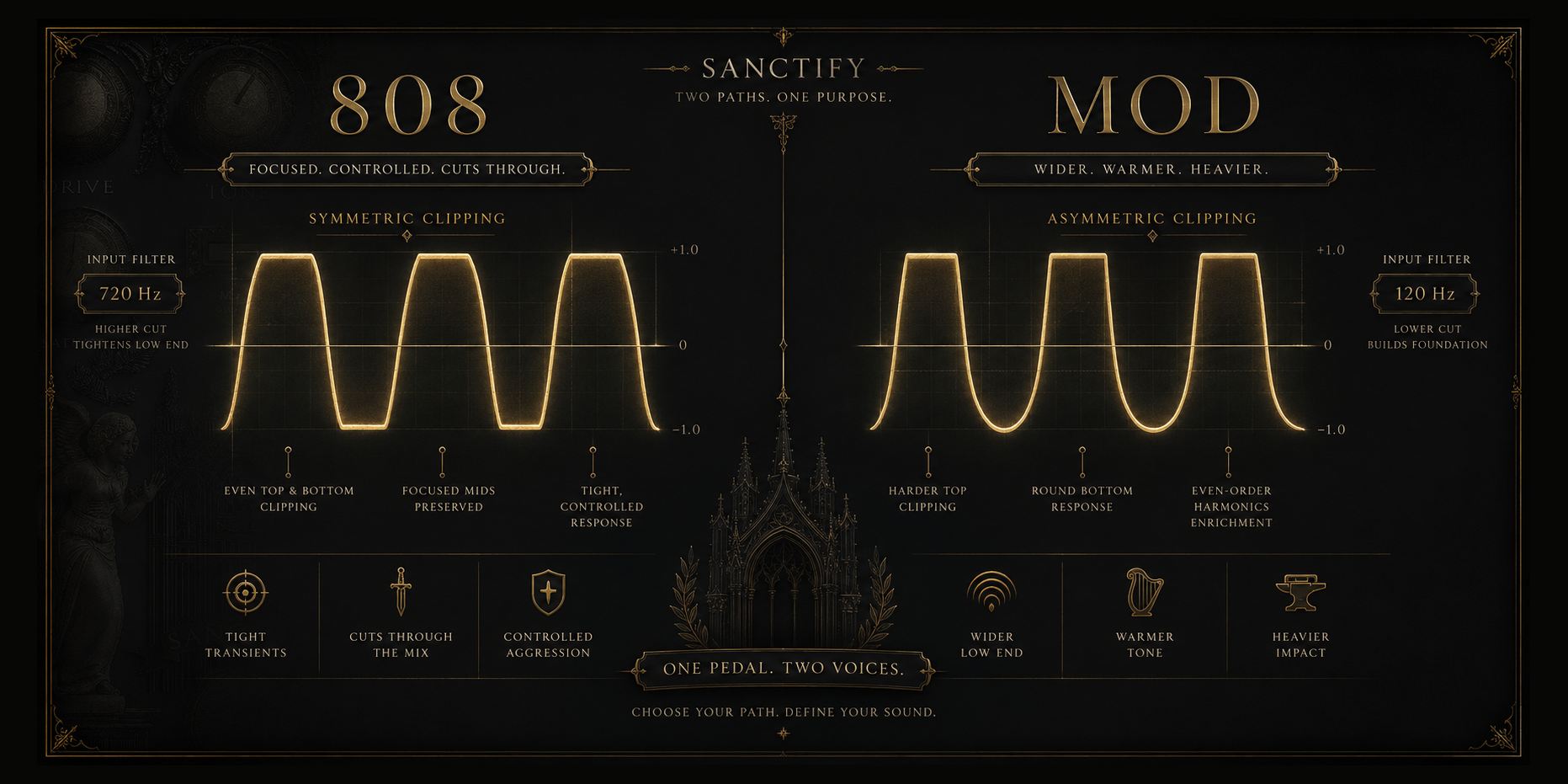
The original voice. Symmetric clipping that treats both halves of the waveform identically — what goes up comes down the same way. A 720 Hz input filter cuts the low end before the signal hits the drive stage, pushing everything through a narrow band where the mid-range lives. The result is focused, aggressive, and cuts through anything sitting around it.
Clean at dawn. Gritty by noon. Unrecognizable by midnight.
Mode Two
Mod
The other voice. Asymmetric clipping — the positive swing is cut short at 0.5 while the negative side gets more room at 0.7. That imbalance is the entire point. It generates even-order harmonics, the same physics that make tube amplifiers sound warm instead of harsh. The input filter drops to 120 Hz, letting the full low end through.
Everything 808 isn't. Wider. Warmer. Heavier.
What it carries
Zero Latency
Real-time processing with no added delay. Play through it live. Track through it. No compensation needed.
True Stereo
Independent left/right processing through separate filter instances. Or sum to mono with one toggle. Gate and restrain stay stereo-linked either way.
4x Oversampled
Drive and saturation run at 4x the host sample rate. Aliasing artifacts are eliminated before they reach the output. Clean harmonics, no digital harshness.
Noise Gate
Input-triggered. Tracks your dry signal, not the distorted output. Responds to what you actually play. Adjustable from gentle cleanup to machine silence.
Restrain
RMS compressor that matches output energy to input energy. Crank the drive without blowing up the mix. Compare settings honestly — volume-matched in real time.
Parallel Mix
Blend your dry signal underneath the distortion. Keep the low-end definition and transient attack while the drive does its work on top. Dead zone near zero prevents accidental bleed.
Built-in randomization
CHAOS
Ten scenes. Each one a different combination of drive, tone, level, saturation, brightness, and clipping mode — generated randomly the first time you open the plugin. Slide through them to find sounds you wouldn't have dialed in yourself. When you land on something, the scene saves your current settings automatically before switching. Nothing gets lost. Everything gets found.
Scene 0 is always your current knob positions. Scenes 1 through 9 are the unknown. All ten persist across sessions, saved with your DAW project and your presets.
Built for the session
Presets
Factory presets give you starting points. Save your own with one click. Full undo — delete a preset by accident, bring it back instantly. Everything uppercase. Everything persistent.
Resize
Three fixed sizes — 50%, 75%, 100%. Click to switch. The interface scales proportionally. Small enough for a crowded plugin chain, large enough to see every detail of the artwork.
Recall
Full state persistence. Every parameter, every CHAOS scene, every GUI preference — saved with your DAW session and restored exactly as you left it. Open the project, pick up where you stopped.
Questions
VST3 in both 32-bit and 64-bit. Compatible with any DAW that supports VST3 on Windows. macOS support is in development — Windows and macOS will be separate releases.
No. Windows and macOS are separate purchases when the macOS version becomes available. Purchasing the Windows version does not guarantee access to the macOS version.
MEOW is a separate plugin by Divine Punishment. Every SANCTIFY purchase includes MEOW at no extra cost. SANCTIFY is delivered instantly. MEOW is delivered within 24 hours via email.
All digital purchases are final due to the nature of downloadable software. Once delivered, the product cannot be returned. If you have issues with installation or activation, contact support and we'll help.
Sanctify uses 4x oversampling on the drive/saturation stage, which is the main CPU cost. On any modern processor it runs comfortably with headroom to spare. No sample libraries are loaded — it's pure DSP, so RAM usage is negligible.
Not currently. The price is $15. We kept it low enough that the barrier to entry is the trial.
Requirements
Format
VST3
Platform
Windows
CPU
x86 / x64
Latency
Zero
GUI
Resizable
About
Divine Punishment's debut album "Infinity" is six tracks of meticulously crafted extremity. Every note, every layer, every sound, built from scratch with no outside input and no creative compromises. The music is orchestrated violence, with each moving part being exactly where it's supposed to be. There's a precision to it, but also an elegance, something closer to composition than chaos.
Infinity is the debut album. Six tracks that move between crushing, calculated aggression and moments of genuine beauty, tied together by a single idea: "Existence itself is the architect of Divine Punishment." Some people will suffer for what they've done, and they won't even know it's happening. That's the concept. That's the sound. And this is only the beginning.
Lore
Divine Punishment is the idea that consequences don't announce themselves. They don't arrive with preface or warning. They're happening right now whether you like it or not. Most people just don't recognize it until it's too late, and some never do.
Infinity was built around that idea. Creation and destruction aren't opposites, they're the same motion observed at different points in the cycle. Everything collapses. Everything begins again. The album is six tracks moving through that loop, and the loop doesn't end when the music stops. Every note was written, performed, produced, and mixed by the same hand.
Infinity eventually ends. But sometimes it's just the beginning.